
Insider information exposes facts about player injuries, team conflicts and strategies.
Why you should not believe insider information?
Insider information is rarely accurate. Clubs and players try to hide important events up to the last minute so as not to tip off their rivals.
Insider information may in fact negatively influence the event. For example, a journalist posts an article about a major transfer coming up based on information from sources close to the club. When posted, this information may be correct: the club has already reached an agreement with the player and almost finalised the transfer. Then after the news, another club intervenes in the deal because it does not want its opponents to get any stronger, so it offers more in an attempt stop it. In the end, the player goes to the second club, and the insider information turns out to be incorrect.
In 2018, Roma arranged for Malcolm's transfer from Bordeaux. The player had already agreed on the contract and the clubs had agreed to the amount of the transfer, but the change in teams was announced on social media. The midfielder was at the airport with tickets to Rome when he was asked by the club to go home.
As it turned out, Barcelona had interfered with the transfer and offered more, and the player was more than happy to be accepted by a more reputable club. Two days later, Malcolm was announced as the newest Barcelona player.
Some clubs and players' agents feed false insiders to the media to gain leverage when negotiating a contract. A club may say it is looking to change up its roster when a player is not performing well to make them play better and not feel indispensable. Agents often spread rumors about competitor interest in their clients to motivate the club to boost their salaries.
One of the most famous examples of insider pressure is from Lionel Messi in Barcelona. Messi was allegedly fighting with the president of the club and the head coach, and constantly on the verge of leaving. Every season there was news of his imminent transfer to Manchester City, PSG, Qatar or the United States. All the while, his salary steadily rose in 2014.
Using insider information, clubs can assess the reaction of their fans to major changes, for example, an increase in the cost of season tickets, the transfer of a problematic player, or dismissal of a coach. If the reaction turns out to be negative, then the idea is simply abandoned.
In 2021, a letter from the chairman of the board of Russian Railways appeared in the press. He was asking the Moscow mayor's office to lease out Luzhniki stadium in exchange for several sports facilities. There was also news of the demolition of the club's home stadium. Fans and the head coach were indignant, and a few days later the club's press service called the letter a fake.
Alleged insider information is popular among scammers trying to make quick money. They invent internal conflicts like quarrels between team leaders or the coach and players, or information about upcoming transfers. Based on this fictitious information, they suggest you place a bet, for example, on a small total, because the team leader does not like the coach's strategy and wants to leave. Or on the team losing because there is a conflict between the players and management about low salaries. However, this information rarely becomes known to outsiders, and if it does, you can learn about it for free from the media.
Who are insiders?
These are people who regularly post insider information. Insiders need to maintain their reputation, so they do not publish news from dubious sources. There are lots of insiders in Russia and around the world, here are just a few of them:
- Gazzetta dello Sport is one of the oldest Italian publications with reliable insiders every week. Although it focuses on the Italian market, it also often publishes information about other championships and even sports. For example, in 2020, Gazzetta dello Sport was the first to write about the termination of the contract between racer Sebastian Vettel and Ferrari.
- Gianluca Di Marzio is an Italian insider and considered one of the most reputable in the world. His site is one of the ten most visited sports platforms in Italy. In 2021, he was the first to mention Donnarumma's transfer from Milan to PSG, and the transfer of head coach Simone Inzaghi from Lazio to Inter. He gets his insiders from everywhere. For example, in 2013, he learned about Tevez's transfer to Juventus from a restaurant dishwasher.
- Fabrizio Romano is another Italian insider working for Sky Sport Italia and The Guardian. He does not publish information until it is confirmed by at least three independent sources. In 2018, he was the first to talk about Ronaldo's transfer to Juventus, and in 2020 he broke the story about Sané's transfer to Bayern Munich and Fernandes to Manchester United.
What is an inside in football?
In football, an inside is the role of an offensive player. These players are between the flank and centre in the line of attack. Their task is to get the ball between the back and central players of the opponent's defence and set up an attack or take a shot on target.
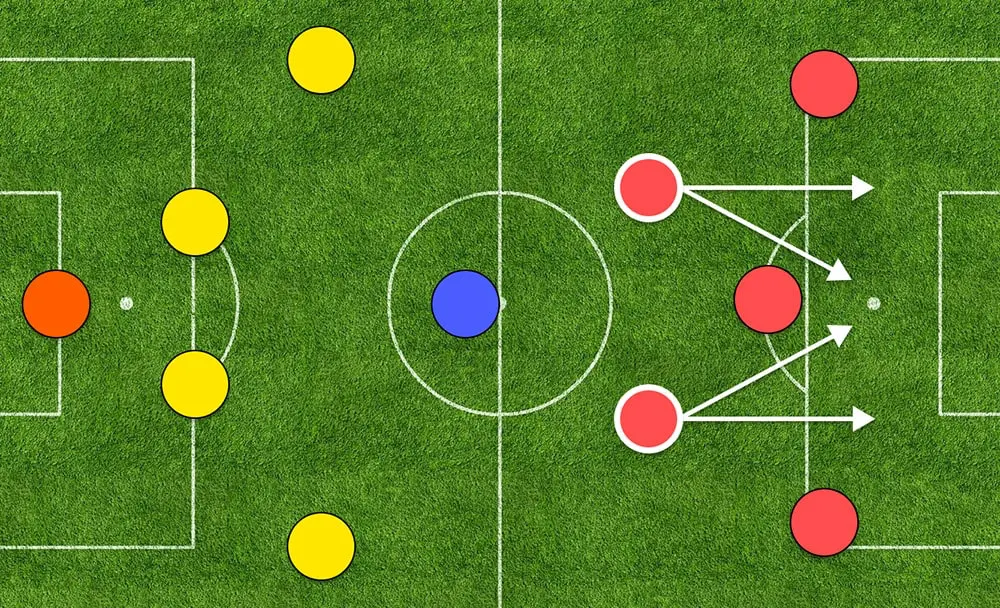
Inside position example. The arrows show the directions of an insider attack
In modern football, these players practically no longer exist. Insider moves are easy to read. With good tactical preparation, defenders simply do not allow such players to get into a proper offensive position.
Today, attacking and midfield players play the role of insides and they are not delegated to specific athletes. Depending on the opponents and coaching strategies, players can carry out different roles in a single match. For example, a midfielder can play offence in the first half, then defence in the second. Also, box-to-box midfielders have become increasingly popular across the entire field, from the opponents' half to their own penalty area.