The summer of 2025 marks a new beginning for the FIFA Club World Cup.
Football is the people’s sport, full of passion, intensity, and – often – disagreements.

The summer of 2025 marks a new beginning for the FIFA Club World Cup.
The tournament takes on a new format, greater prestige, and aims to become the "World Cup" for the planet's top clubs. With a new structure, 32 participating teams, and a packed match schedule, the competition is set to captivate millions of fans across the globe.
When and where it takes place
When and where it takes place
The FIFA Club World Cup 2025 will be held in the United States of America from June 15 to July 13, 2025. This will be the first time the tournament spans such a long duration — around 30 days of action — following the format of the FIFA World Cup for national teams.
The USA, with its vast experience in organizing major sporting events and in light of the upcoming FIFA World Cup 2026, is considered an ideal host. Matches will be played in several cities with modern stadiums, including New York, Los Angeles, Miami, Dallas, and Atlanta, among others.
The big change: 32 Teams
The big change: 32 Teams
The most significant change in the FIFA Club World Cup 2025 compared to previous editions is the number of participating teams. From just 7 teams in past tournaments, it now expands to 32 clubs, making the event much more competitive and commercially attractive.
Teams qualify by winning the most prestigious continental club competitions (Champions League, Copa Libertadores, AFC Champions League, etc.), while additional spots are awarded based on a special ranking system.
Spot Allocation:
Spot Allocation:
- UEFA (Europe) – 12 teams
- CONMEBOL (South America) – 6 teams
- CAF (Africa) – 4 teams
- AFC (Asia) – 4 teams
- CONCACAF (North & Central America) – 4 teams
- OFC (Oceania) – 1 team
- USA (Host nation) – 1 team
Teams already qualified
Teams already qualified
Several teams have already secured their participation, either as winners of continental competitions in recent years or based on their rankings. Among them are some of the most renowned clubs in world football:
From Europe (UEFA):
From Europe (UEFA):
- Real Madrid (Champions League winners 2021–22)
- Manchester City (Champions League winners 2022–23)
- Chelsea (Champions League winners 2020–21)
- Bayern Munich (likely based on ranking)
- Paris Saint-Germain, Inter, Barcelona, Liverpool, and other high-ranking teams
From South America (CONMEBOL):
From South America (CONMEBOL):
- Palmeiras, Flamengo, Fluminense (Copa Libertadores winners)
- Boca Juniors and others based on rankings
From Asia (AFC), Africa (CAF), and North America (CONCACAF):
From Asia (AFC), Africa (CAF), and North America (CONCACAF):
- Al Hilal, Al Ahly, Monterrey, Club León, Urawa Red Diamonds
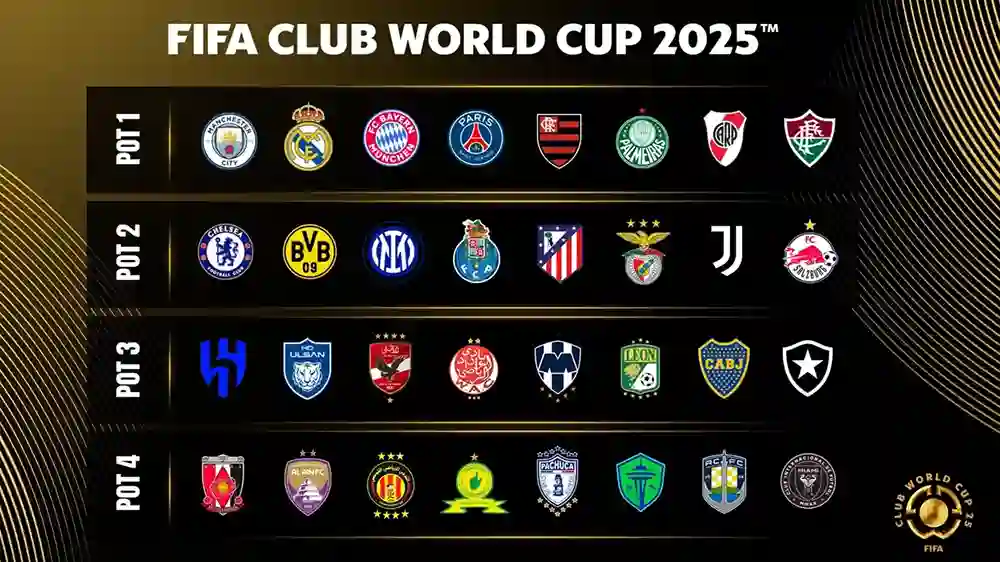
*Pot allocation for the FIFA Club World Cup 2025
Pot 1:
Manchester City (ENG), Real Madrid C. F. (ESP), FC Bayern München (GER), Paris Saint-Germain (FRA), CR Flamengo (BRA), SE Palmeiras (BRA), CA River Plate (ARG), Fluminense FC (BRA)
Pot 2:
Chelsea FC (ENG), Borussia Dortmund (GER), FC Internazionale Milano (ITA), FC Porto (POR), Atlético de Madrid (ESP), SL Benfica (POR), Juventus FC (ITA), FC Salzburg (AUT)
Pot 3:
Al Hilal (KSA), Ulsan HD (KOR), Al Ahly FC (EGY), Wydad AC (MAR), CF Monterrey (MEX), Club León (MEX), CA Boca Juniors (ARG), Botafogo (BRA)
Pot 4:
Urawa Red Diamonds (JPN), Al Ain FC (UAE), Espérance Sportive de Tunisie (TUN), Mamelodi Sundowns FC (RSA), CF Pachuca (MEX), Seattle Sounders FC (USA), Auckland City FC (NZL), Inter Miami CF (USA)
Tournament format
Tournament format
The tournament will be divided into eight groups of four teams. The top two teams from each group will advance to the Round of 16, which marks the beginning of the knockout stage. There will be no third-place match, and the final is scheduled for July 13, 2025.
A total of 63 matches will be played — a record number for any FIFA club competition.
History of the FIFA Club World Cup
History of the FIFA Club World Cup
The FIFA Club World Cup began in 2000 in Brazil, aiming to crown the best football club in the world. It essentially replaced the Intercontinental Cup, which was contested between the champions of Europe and South America.
Since 2005, the tournament became an annual event, hosted primarily in Japan, the United Arab Emirates, and Qatar. While the previous format with 7 teams (6 continental champions + 1 host champion) was considered limited, it still showcased some epic matchups.
What this means for Global Football
What this means for Global Football
The upgrade of the tournament signals FIFA’s intention to strengthen the global brand of club football and create new revenue streams. The new format closely resembles the FIFA World Cup for national teams, promising greater spectacle and commercial appeal.
At the same time, it provides clubs outside Europe the opportunity to face elite European teams on the big stage — attracting new audiences and offering global exposure.
Looking ahead to summer 2025
Looking ahead to summer 2025
The FIFA Club World Cup 2025 is eagerly awaited. The participation of the world’s top clubs, the staging in state-of-the-art American stadiums, and the tournament’s revamped format make it a global football celebration.
Football fans can’t wait to see legendary teams like Real Madrid, Manchester City, Flamengo, and many others battle for global glory at the highest level.


