Diego Armando Maradona was not just a footballer.
Diego Armando Maradona was not just a footballer.

Diego Armando Maradona was not just a footballer.
He was a global phenomenon, living proof that football can transcend the boundaries of sport to become a social phenomenon, a political statement, even a religion. Born on October 30, 1960, in Lanús, Argentina, and raised in the poor neighborhood of Villa Fiorito, Diego rose from the mud to become the brightest star the beautiful game has ever known.
Early steps: The Wonder Kid
Maradona’s story reads like a fairy tale. By the age of three, he had already learned to dribble. At eight, he joined the youth teams of Argentinos Juniors, and at fifteen, he made his professional debut. From the very first game, it was clear that something extraordinary had arrived. His control, his balance, his vision on the pitch — he stood out immediately.
From Argentina to Europe
From Argentina to Europe
His move to Boca Juniors in 1981 marked the first big step in his career. In less than a year, he had become a club legend, leading them to win the championship. In 1982, after the World Cup in Spain, he transferred to Barcelona. Despite moments of magic, recurring injuries and off-field issues prevented him from fully unleashing his talent in Catalonia.
But the real epic began in 1984, when he moved to Napoli.
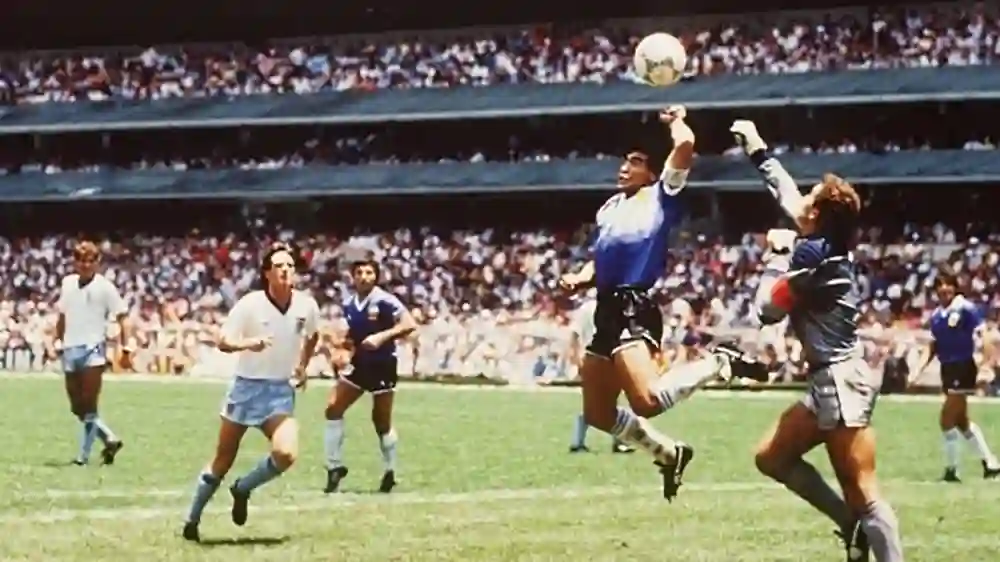
*This photo is from the 1986 World Cup quarter-final against England, taken just moments before he scored the "Goal of the Century."
Napoli: The God of Southern Italy
Napoli: The God of Southern Italy
Historically, Napoli was a team that flirted with relegation. The city, scorned by Northern Italy, carried deep social and class wounds. With Maradona’s arrival, however, Naples found its hero. Diego was not just the team’s captain — he became the symbol of dignity for the poor. With Napoli, he won two Serie A titles (1987 and 1990), a Coppa Italia (1987), a Supercoppa Italiana (1990), and the UEFA Cup (1989).
His relationship with Napoli was almost mystical. There, he was worshipped like a deity, with murals, statues, and countless songs dedicated to his name. The image of him in the blue jersey, with the ball glued to his left foot, became a symbol of hope.
World Cup 1986: The peak of his career
World Cup 1986: The peak of his career
The 1986 World Cup in Mexico belongs entirely to Diego Maradona. He was the captain, the leader, the creator and finisher of an unstoppable Argentina. In the quarter-final against England, he made history: first with the infamous “Hand of God,” then with the “Goal of the Century,” a solo effort so brilliant even opponents applauded. That World Cup was his — he lifted the trophy, and with it, an entire nation.
Fall and Comeback
Fall and Comeback
The years that followed were not easy. His addiction to cocaine, his connections with the mafia, and his personal struggles haunted him. In 1991, he was banned for drug use and left Napoli. He continued his career at Sevilla, Newell’s Old Boys, and returned to Boca Juniors, but never regained his former glory.
At the 1994 World Cup in the U.S., he seemed to be back to his old self. But the dream was cut short when he tested positive for banned substances and was expelled from the tournament. It was the beginning of the end of his playing career.
After Football: The Man Maradona
After Football: The Man Maradona
After retiring from football, Diego fought battles with his health and his inner demons. He was hospitalized several times, underwent surgeries, and struggled with obesity and addiction. But he never lost the love of the people.
In 2008, he became head coach of the Argentine national team. Although the team didn’t go far in the 2010 World Cup, Maradona reconnected with Argentinians as a beloved figure. In the final years of his life, he coached various clubs in Argentina and abroad, always with passion and heart.
Death and Immortality
Death and Immortality
On November 25, 2020, the world froze. Diego Maradona passed away from cardiac arrest at the age of 60. The mourning was global. Argentina declared three days of national mourning, and people from every corner of the planet paid tribute. Stadiums, walls, and plazas were filled with his image. A mortal had become immortal.
Legacy and Heritage
Legacy and Heritage
Diego Maradona wasn’t just a great player. He was a people’s hero. He represented the oppressed, the wronged, those without a voice. He never hesitated to speak politically, to stand against authority, to support those he loved — no matter the cost.
The jersey with the number 10 is not just a number. It is a legacy, a symbol, and in football, it is synonymous with Maradona.


